

science.nasa.gov
Summarize this content to 100 words:
Curiosity Navigation
Curiosity Home
Mission Overview
Where is Curiosity?
Mission Updates
Science
Overview
Instruments
Highlights
Exploration Goals
News and Features
Multimedia
Curiosity Raw Images
Images
Videos
Audio
Mosaics
More Resources
Mars Missions
Mars Sample Return
Mars Perseverance Rover
Mars Curiosity Rover
MAVEN
Mars Reconnaissance Orbiter
Mars Odyssey
More Mars Missions
Mars Home
2 min read
Curiosity Blog, Sols 4788-4797: Welcome Back from Conjunction
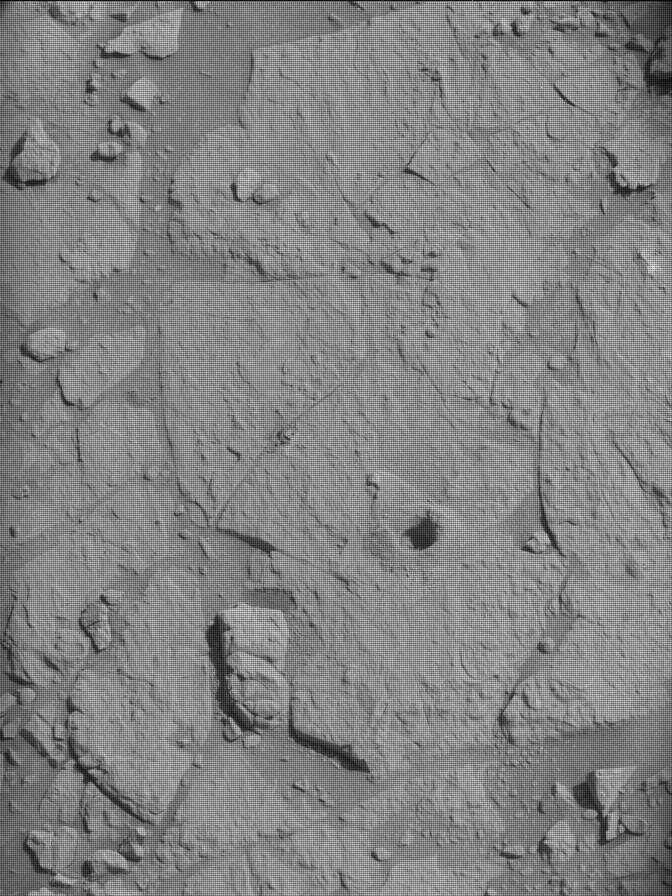
NASA’s Mars rover Curiosity acquired this image using its Mast Camera (Mastcam); it shows the “Nevado Sajama” drill site from November, right next to the location of this weekend’s drill. The new drill site will be to the upper left of the existing hole. Curiosity captured the image on Jan. 25, 2026 — Sol 4789, or Martian day 4,789 of the Mars Science Laboratory mission — at 19:20:37 UTC.
NASA/JPL-Caltech/MSSS
Written by Alex Innanen, Atmospheric Scientist at York University, Toronto
Earth planning date: Friday, Jan. 30, 2026
Mars has emerged from its holiday behind the Sun, and we here on Earth have been able to reconnect with Curiosity and get back to work on Mars. Our first planning day last Friday gave Curiosity a full weekend of activities, which wrapped up with getting us ready for our next drill. We checked out a broken white rock in the workspace with APXS, MAHLI, and ChemCam’s laser spectrometer and finished up imaging a sandy area we’ve kept an eye on during conjunction to see if we could catch any wind motion, before taking a small drive to our drill location about 2 meters away (about 6 feet).
This location may look familiar — our next drill will be only a few centimeters away from “Nevado Sajama,” which we drilled back in November. The reason we’ve returned here is to do a rare SAM experiment the instrument’s last container of tetramethylammonium hydroxide (or TMAH, for less of a mouthful). TMAH is a chemical that we can mix with our sample from Nevado Sajama to help identify any organic molecules. SAM had only two containers of TMAH (the first of which we used almost six years ago, so we want to be very certain that everything will go well with this experiment. As a result, we did a rehearsal of the handoff of the sample to SAM in Wednesday’s plan, before we drill this weekend.
Want to read more posts from the Curiosity team?
Visit Mission Updates
Want to learn more about Curiosity’s science instruments?
Visit the Science Instruments page
NASA’s Mars rover Curiosity at the base of Mount Sharp
NASA/JPL-Caltech/MSSS
Share
Details
Last Updated
Feb 04, 2026
Related Terms
Blogs
Explore More
3 min read
Curiosity Blog, Sols 4750-4762: See You on the Other Side of the Sun
Article
1 month ago
3 min read
Wind-Sculpted Landscapes: Investigating the Martian Megaripple ‘Hazyview’
Article
2 months ago
3 min read
Curiosity Blog, Sols 4743-4749: Polygons in the Hollow
Article
2 months ago
Keep Exploring
Discover More Topics From NASA
Mars
Mars is the fourth planet from the Sun, and the seventh largest. It’s the only planet we know of inhabited…
All Mars Resources
Explore this collection of Mars images, videos, resources, PDFs, and toolkits. Discover valuable content designed to inform, educate, and inspire,…
Rover Basics
Each robotic explorer sent to the Red Planet has its own unique capabilities driven by science. Many attributes of a…
Mars Exploration: Science Goals
The key to understanding the past, present or future potential for life on Mars can be found in NASA’s four…
