

science.nasa.gov
Summarize this content to 100 words:
Explore Hubble
Hubble Home
Overview
About Hubble
The History of Hubble
Hubble Timeline
Why Have a Telescope in Space?
Hubble by the Numbers
At the Museum
FAQs
Impact & Benefits
Hubble’s Impact & Benefits
Science Impacts
Cultural Impact
Technology Benefits
Impact on Human Spaceflight
Astro Community Impacts
Science
Hubble Science
Science Themes
Science Highlights
Science Behind Discoveries
Universe Uncovered
Hubble’s Partners in Science
Hubble & Citizen Science
AI & Hubble Science
Explore the Night Sky
Observatory
Hubble Observatory
Hubble Design
Mission Operations
Science Operations
Astronaut Missions to Hubble
Hubble vs Webb
Team
Hubble Team
Career Aspirations
Hubble Astronauts
Multimedia
Images
Videos
Sonifications
Podcasts
e-Books
Online Activities
3D Hubble Models
Lithographs
Fact Sheets
Posters
Hubble on the NASA App
Glossary
News
Hubble News
Social Media
Media Resources
More
35th Anniversary
Online Activities
4 Min Read
AI Unlocks Hundreds of Cosmic Anomalies in Hubble Archive
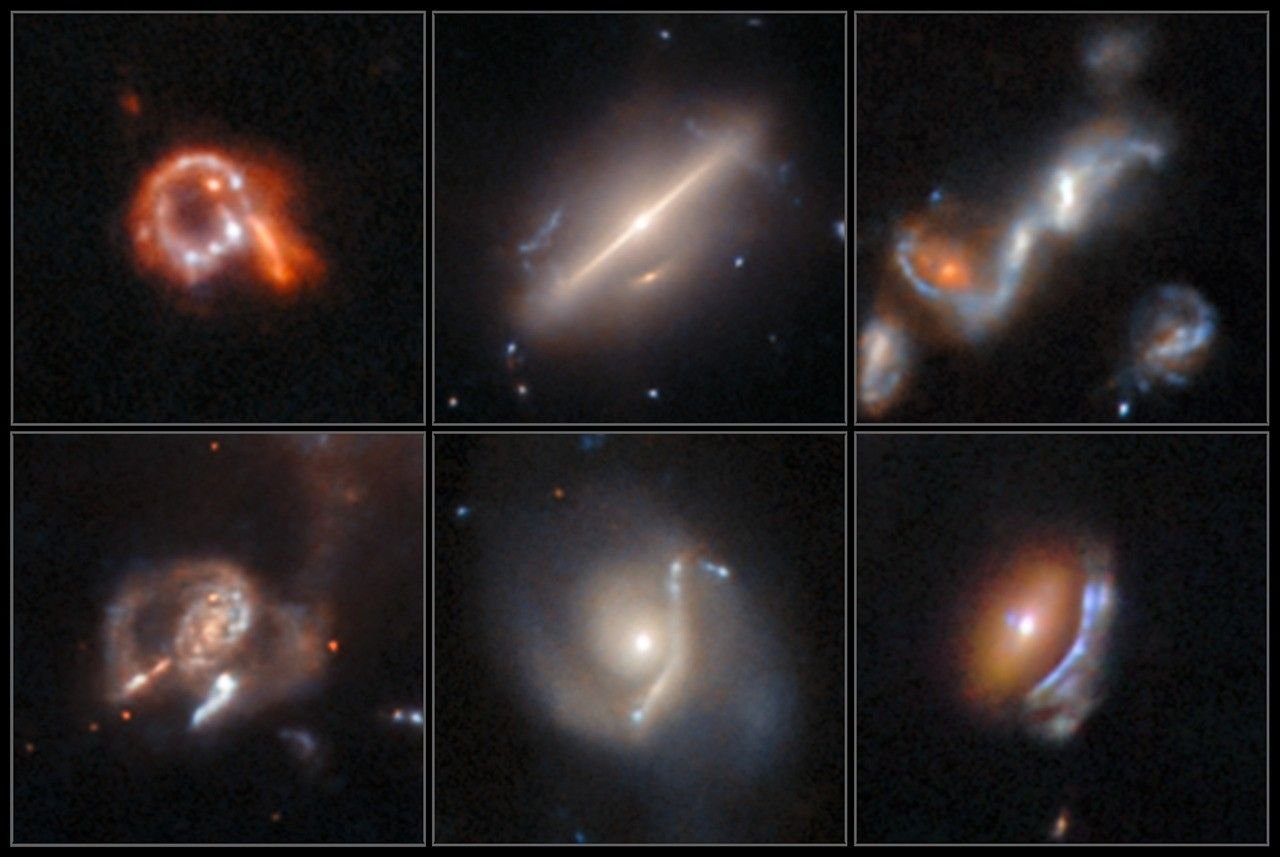
This collection features six images of galaxies discovered within archived data from NASA’s Hubble Space Telescope.
Credits:
Image: NASA, ESA, David O’Ryan (ESA), Pablo Gómez (ESA), Mahdi Zamani (ESA/Hubble)
A team of astronomers has employed a cutting-edge, artificial intelligence-assisted technique to uncover rare astronomical phenomena within archived data from NASA’s Hubble Space Telescope. The team analyzed nearly 100 million image cutouts from the Hubble Legacy Archive, each measuring just a few dozen pixels (7 to 8 arcseconds) on a side. They identified more than 1,300 objects with an odd appearance in just two and a half days — more than 800 of which had never been documented in scientific literature.
Most of the anomalies were galaxies undergoing mergers or interactions, which exhibit unusual morphologies or trailing, elongated streams of stars and gas. Others were gravitational lenses, where the gravity of a foreground galaxy distorts spacetime and bends light from a background galaxy into arcs or rings. Additional discoveries included galaxies with massive star-forming clumps, jellyfish-looking galaxies with gaseous “tentacles,” and edge-on planet-forming disks in our own galaxy resembling hamburgers. Remarkably, several dozen objects defied existing classification schemes entirely.
Identifying such a diverse array of rare objects within the vast and growing repository of Hubble and other telescope data presents a formidable challenge. Never in the history of astronomy has such a volume of observational data been available for analysis.
To address this challenge, researchers David O’Ryan and Pablo Gómez of ESA (the European Space Agency) developed an AI tool capable of inspecting millions of astronomical images in a fraction of the time required by human experts. Their neural network, named AnomalyMatch, was trained to detect rare and unusual objects by recognizing patterns in data — mimicking the way the human brain processes visual information.
Six previously undiscovered, weird and fascinating astrophysical objects are displayed in this new image from NASA’s Hubble Space Telescope. They include three lenses with arcs distorted by gravity, one galactic merger, one ring galaxy, and one galaxy that defied classification.
Image: NASA, ESA, David O’Ryan (ESA), Pablo Gu00f3mez (ESA), Mahdi Zamani (ESA/Hubble)
“Archival observations from the Hubble Space Telescope now span 35 years, offering a rich dataset in which astrophysical anomalies may be hidden,” said David O’Ryan, lead author of the study published in Astronomy & Astrophysics.
Traditionally, anomalous images are discovered through manual inspection or serendipitous observation. While expert astronomers excel at identifying unusual features, the sheer volume of Hubble data makes comprehensive manual review impractical. Citizen science initiatives have helped expand the scope of data analysis, but even these efforts fall short when faced with archives as extensive as Hubble’s or those from wide-field survey telescopes like Euclid, an ESA mission with NASA contributions.
The work by O’Ryan and Gómez represents a significant advancement. By applying AnomalyMatch to the Hubble Legacy Archive, they conducted the first systematic search for astrophysical anomalies across the entire dataset. After the algorithm flagged likely candidates, the researchers manually reviewed the top-rated sources and confirmed more than 1,300 as true anomalies.
“This is a powerful demonstration of how AI can enhance the scientific return of archival datasets,” Gómez said. “The discovery of so many previously undocumented anomalies in Hubble data underscores the tool’s potential for future surveys.”
Hubble is just one of many astronomical archives poised to benefit from AI-driven analysis. Facilities such as NASA’s upcoming Nancy Grace Roman Space Telescope, a well as ESA’s Euclid and the National Science Foundation and Department of Energy’s Vera C. Rubin Observatory, will generate unprecedented volumes of data. Tools like AnomalyMatch will be essential for navigating this data deluge, enabling astronomers to uncover new and unexpected phenomena — and perhaps even objects never before seen in the universe.
The Hubble Space Telescope has been operating for over three decades and continues to make ground-breaking discoveries that shape our fundamental understanding of the universe. Hubble is a project of international cooperation between NASA and ESA. NASA’s Goddard Space Flight Center in Greenbelt, Maryland, manages the telescope and mission operations. Lockheed Martin Space, based in Denver, also supports mission operations at Goddard. The Space Telescope Science Institute in Baltimore, which is operated by the Association of Universities for Research in Astronomy, conducts Hubble science operations for NASA.
Facebook logo
@NASAHubble
@NASAHubble
Instagram logo
@NASAHubble
Related Images & Videos
Astrophysical Anomalies from Hubble’s Archive
Six previously undiscovered, weird and fascinating astrophysical objects are displayed in this new image from NASA’s Hubble Space Telescope. They include three lenses with arcs distorted by gravity, one galactic merger, one ring galaxy, and one galaxy that defied classification.
Share
Details
Last Updated
Jan 27, 2026
Editor
Andrea Gianopoulos
Location
NASA Goddard Space Flight Center
Contact
Media
Claire Andreoli
NASA’s Goddard Space Flight Center
Greenbelt, Maryland
claire.andreoli@nasa.gov
Bethany Downer
ESA/Hubble
Garching, Germany
Ann Jenkins and Christine Pulliam
Space Telescope Science Institute
Baltimore, Maryland
Related Terms
Hubble Space Telescope
Astrophysics
Astrophysics Division
Galaxies
Goddard Space Flight Center
Gravitational Lensing
Irregular Galaxies
Origin & Evolution of the Universe
The Universe
Related Links and Documents
Science Paper: Identifying astrophysical anomalies in 99.6 million source cutouts from the Hubble legacy archive using AnomalyMatch, PDF (47.32 MB)
Release on ESA/Hubble Website
Keep Exploring
Discover More Topics From Hubble
Hubble Space Telescope
Since its 1990 launch, the Hubble Space Telescope has changed our fundamental understanding of the universe.
AI and Hubble Science
Hubble Science Highlights
Hubble Images
