

science.nasa.gov
Summarize this content to 100 words:
Earth Observatory
Science
Earth Observatory
Seasons Change in Southwest…
Earth
Earth Observatory
Image of the Day
EO Explorer
Topics
All Topics
Atmosphere
Land
Heat & Radiation
Life on Earth
Human Dimensions
Natural Events
Oceans
Remote Sensing Technology
Snow & Ice
Water
More Content
Collections
Global Maps
World of Change
Articles
Notes from the Field Blog
Earth Matters Blog
Blue Marble: Next Generation
EO Kids
Mission: Biomes
About
About Us
Subscribe
🛜 RSS
Contact Us
Search
To view this video please enable JavaScript, and consider upgrading to a web browser that
supports HTML5 video
October 4–December 6, 2025
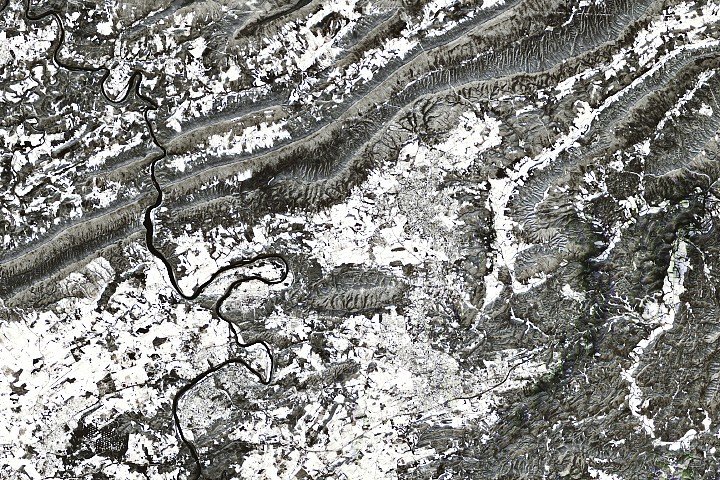
As the seasons sweep through southwest Virginia, the lush summer landscape transforms, fading into fall and winter.
From October 4 to December 6, 2025, the forests in this animation turn from green to orange to brown before being blanketed by white snow. The animation is composed of images from Harmonized Landsat and Sentinel-2 (HLS), a NASA product that combines imagery from the NASA/USGS Landsat 8 and Landsat 9 satellites and the European Space Agency’s Sentinel-2A, 2B, and 2C satellites.
The animation showcases the Valley and Ridge province of the Appalachian Mountains, named for its characteristic parallel ridges and valleys. When the supercontinent Pangea formed, the region was compressed, one of the factors producing this folded landscape.
The region’s forests, largely deciduous, undergo color change in the fall before shedding their leaves. Certain species change color earlier, while others lose their green pigment later in the season. Because of Virginia’s rich tree diversity—nearly 100 species of deciduous trees are native to the state—the landscape becomes a patchwork of shifting colors.
December 6, 2025
Paige Williams, an assistant professor in the School of Life Sciences and Sustainability at Virginia Commonwealth University, identified several notable landscape changes captured in the video. Price Mountain, with nearly entirely deciduous forests, appears bright orange in early November and then fades to brown by mid-month.
Northeast of Price Mountain, Blacksburg—home of Virginia Tech—maintains a backdrop of green and gray. Ellet Valley, east of town, stays green until early December, long after surrounding ridgelines fade to brown, due to irrigated agricultural fields, cattle grazing, and golf courses. Evergreens, which retain their foliage year-round, dot the scene with dark green and thrive most on north-facing slopes.
Nearly 80 percent of Virginia’s forests are deciduous or a mix of deciduous and pine trees. Deciduous trees lose their leaves every fall in a process called senescence. As days get shorter and temperatures drop, chlorophyll (which gives leaves their green color) begins to break down, revealing other carotenoid plant pigments, usually yellow and orange hues hidden during the spring and summer. Some trees produce new pigments that turn leaves red. Before the leaves fall, the trees absorb as many of their nutrients as possible, recycling them for future growth.
In early December, a rare early-season snowstorm visited Virginia. Snow covered the landscape, sliding off steeper slopes and collecting in valleys and flatlands. The National Weather Service reported that by the month’s end, Blacksburg had collected a total of 8.6 inches (22 centimeters) of snow—nearly 4 inches more than the 1991–2020 average for December.
Animation by Ross Walter/Landsat Science Office Support, using data from the Harmonized Landsat and Sentinel-2 (HLS) product. Still image by Lauren Dauphin/NASA Earth Observatory using Landsat data from the U.S. Geological Survey. Story by Madeleine Gregory/Landsat Project Science Support.
Downloads
December 6, 2025
JPEG (5.01 MB)
October 4–December 6, 2025
MP4 (43.69 MB)
References & Resources
National Park Service (2018, May 1) Valley and Ridge Province. Accessed January 28, 2026.
National Weather Service, Blacksburg, VA. Accessed January 28, 2026.
Smithsonian (2021, September 21) Why do leaves change color in the fall? Accessed January 28, 2026.
Virginia Department of Forestry, Hardwood Management. Accessed January 28, 2026.
You may also be interested in:
Stay up-to-date with the latest content from NASA as we explore the universe and discover more about our home planet.
Autumn in the Ozarks
3 min read
Late-season reds and browns swept across the Ozark Highlands in the south-central U.S.
Article
Rewilding South Africa’s Greater Kruger
5 min read
Satellites are helping land managers track ecological shifts as reserves reconnect and landscapes return to a more natural state.
Article
Color Along the Anadyr
2 min read
Across the northeastern Siberian tundra, summer greens shift to vibrant reds, yellows, and browns as temperatures drop and days shorten.
Article
1
2
3
4
Next
Keep Exploring
Discover More from NASA Earth Science
Subscribe to Earth Observatory Newsletters
Subscribe to the Earth Observatory and get the Earth in your inbox.
Earth Observatory Image of the Day
NASA’s Earth Observatory brings you the Earth, every day, with in-depth stories and stunning imagery.
Explore Earth Science
Earth Science Data
